
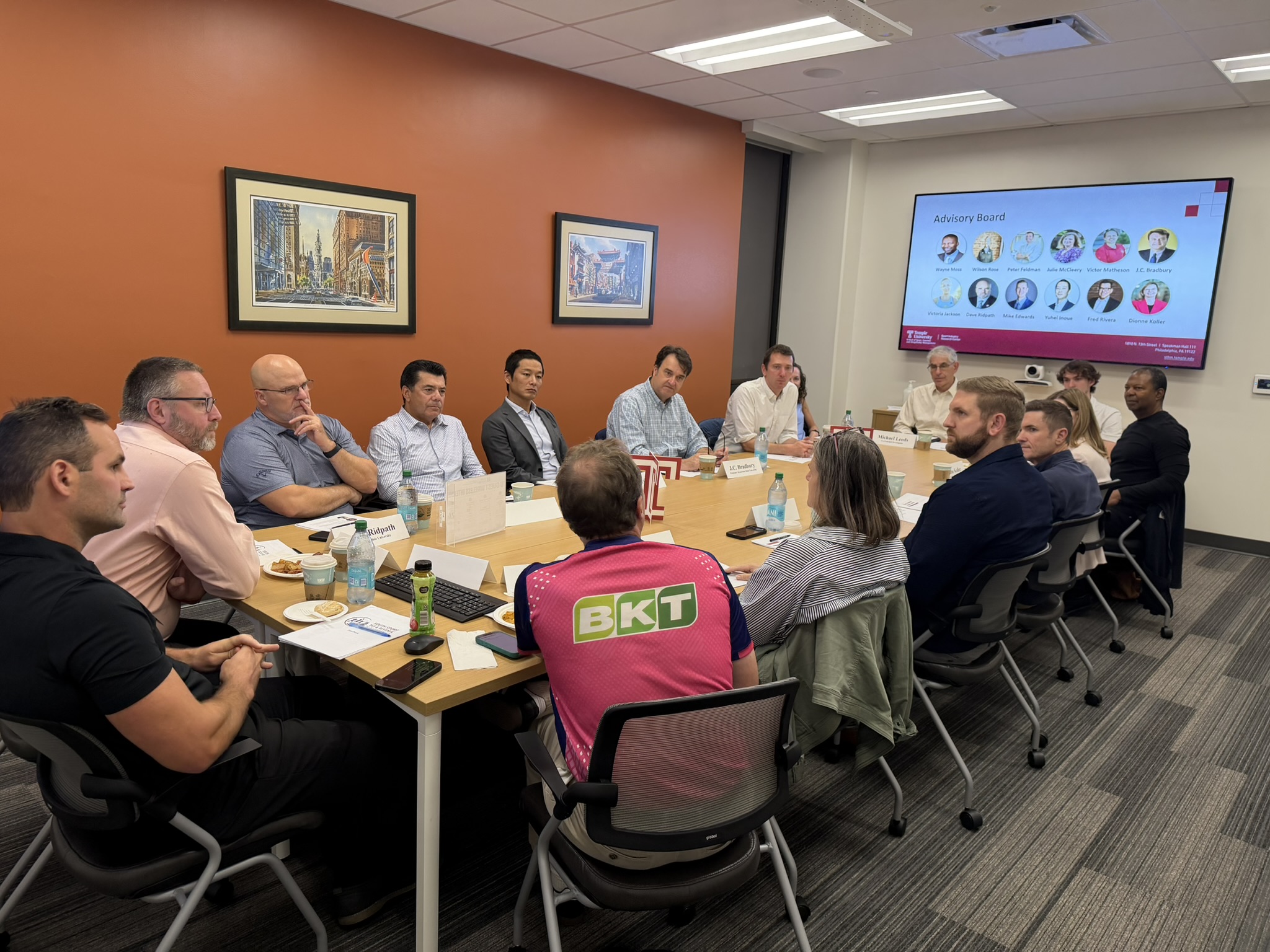
Temple University’s Sport Industry Research Center (SIRC) recently hosted the first convening of the Youth Sport Tax & Revenue Policy Consortium, bringing together a multidisciplinary advisory board to begin addressing one of the more complex systems-level questions facing youth sport: how tax and public financing strategies can be used to support accessible, high-quality sport opportunities for young people. The Consortium is supported by a grant from the Susan Crown Exchange that was awarded to SIRC as part of the Million Coaches Challenge’s Empower Every Coach Cohort, a national initiative to advance systems-level change in youth sports.
The convening marked an early milestone in an 18-month initiative led by SIRC. The Consortium will consider not only how public funds are generated and allocated, but also how funding mechanisms can encourage practices that support positive youth development, including areas such as coach training.
The consortium is organized around four central areas of inquiry:
- identifying appropriate strategies for generating public funding for youth sport
- understanding how revenue can be reinvested to improve access and quality
- examining compliance frameworks that can encourage providers receiving public support to follow established best practices
- considering how economic development objectives can be balanced with broader youth well-being.
Central to that work is the advisory board. The 12-member group brings together expertise spanning youth sport delivery, economics, public finance, history, policy, law, social impact and sport-based youth development. Its role is to help inform the research methodology, critically review and interpret findings, and contribute to the development of the project’s final outputs.
SIRC is leading the project’s data collection and analysis through an interdisciplinary Temple leadership team that includes Gareth Jones, Michael Leeds, Bradley Baker and George Diemer. The structure combines Temple’s research expertise with the advisory board’s range of academic, industry, nonprofit and policy perspectives.
The first convening was designed to establish the foundation for that collaboration by bringing together researchers and industry professionals with multidisciplinary expertise to better understand how public financing systems can support access, quality and evidence-informed policy across youth sport.
“It is rare to get experts from such a wide range of disciplines in the same place to talk about a complex issue facing the youth sport industry. This convening allowed us to establish a clear direction for the Consortium, and I am excited to see where this work will take us.” – Gareth Jones, principal investigator
With a clear direction now established, the Consortium will review legislative and finance data to learn more about existing tax and revenue strategies being utilized in the United States, with key informant interviews planned as the project progresses. The Consortium will also draw on relevant international comparisons to identify alternative approaches and points of difference. The work will ultimately lead to several white papers that provide an overview of the findings to help inform how public financing may be leveraged to provide accessible, high-quality sport opportunities for young people.
We thank the advisory board for lending their time, energy, and expertise to this project.
- Dave Ridpath, Ohio University
- Dionne Koller, University of Baltimore
- Fred Rivera, The Rivera Group
- J.C. Bradbury, Kennesaw State University
- Julie McCleery, University of Washington
- Michael Edwards, North Carolina State University
- Peter Feldman, Laureus USA
- Victor Matheson, College of the Holy Cross
- Victoria Jackson, Arizona State University
- Wilson Rose, Kids in the Game
- Wayne Moss, National Council of Youth Sports
- Yuhei Inoue, University of Illinois