
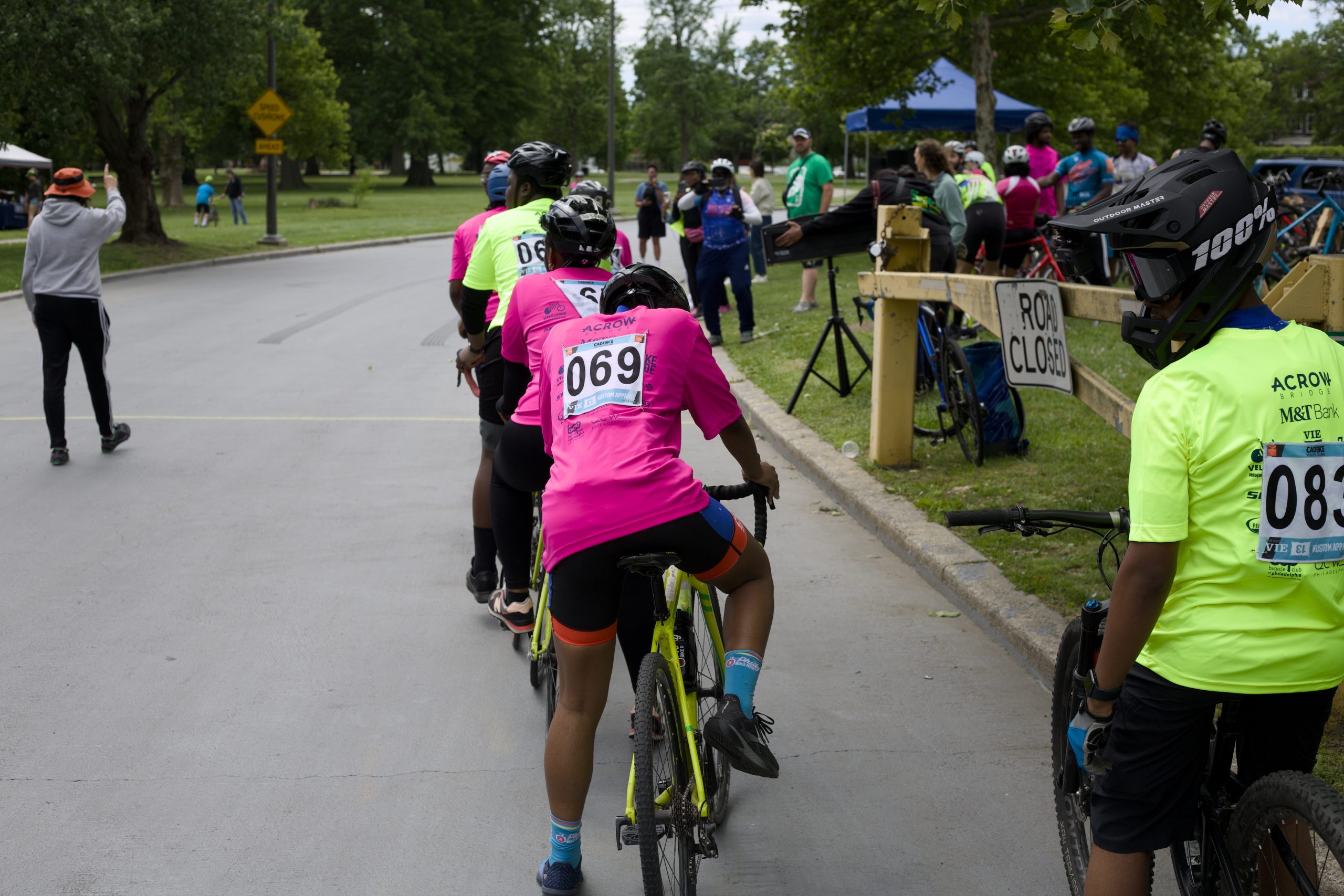
Supported by an Outride Research Partnership Grant, the collaboration will examine how young people experience BCYC over time while building the program’s long-term capacity to collect and use evaluation data.
Temple University’s Sport Industry Research Center (SIRC) and the Bicycle Coalition of Greater Philadelphia (BCGP) were selected as one of only 11 recipients of Outride’s Research Partnership Grant, which connects researchers and community organizations to study and strengthen cycling-based initiatives that promote brain health and well-being. The grant supports community-academic partnerships that strengthen evaluation capacity and translate research into practice.
“Participation counts show reach, but they do not show whether young people feel connected and motivated to remain involved. Going beyond the number of participants to see if sustained involvement in the program produces positive changes in feelings and attitudes is really getting more to the heart of the BCGP mission,” said Aubrey Kent, professor at Temple University’s School of Sport, Tourism and Hospitality Management (STHM) and co-lead on the evaluation.
The evaluation will focus on BCGP’s flagship Bicycle Coalition Youth Cycling (BCYC) program.
“We know from working directly with our young people that BCYC has an impact that goes well beyond learning how to ride a bike. We see growth in confidence, leadership, relationships, independence, and young people’s willingness to challenge themselves. We wanted an evaluation process that reflects what BCYC actually does and the experiences of the young people we serve, rather than trying to fit the program into a generic set of measures,” said Habib Faye, BCYC Program Coordinator at the Bicycle Coalition of Greater Philadelphia.
The approach to evaluation is being developed collaboratively, with BCYC bringing direct knowledge of its participants, programming and the communities it serves in Philadelphia, and SIRC contributing expertise in research design, assessment, data analysis and interpretation. As part of the grant, BCYC will be able to hire a part-time staff member to focus on building its internal capacity for measurement and evaluation.
“This project aligns closely with SIRC’s mission to have a direct impact on sport organizations. Beyond evaluating outcomes, we have an opportunity to help the Bicycle Coalition of Greater Philadelphia build the tools and capacity to evaluate its programs, use data to make decisions, and demonstrate its impact over the long term,” said Gareth Jones, associate professor at STHM and director of SIRC.
The evaluation will involve collecting participant surveys during the 2026-27 program year to examine how perceptions of the program, coaches and peers are associated with physical activity, self-regulation and other measures of social and emotional learning. Focus groups will also be used to further explore participant perspectives at the end of each program season.
For BCYC, a central question is how young people experience the program over time and which parts of that experience contribute most to their growth.
“The key for us is understanding not just whether youth cycling programs have an impact, but how and why that impact occurs. In particular, we hope to identify how experiences such as relationships with coaches and connection to the program contribute to young people’s social, emotional, cognitive, and physical development,” Jones said.
As the project moves forward, SIRC and BCYC will use the evaluation to develop practical reports and resources, including tools that can support BCYC’s future evaluation work. The larger goal is to make data collection and interpretation useful for ongoing program decisions rather than treating evaluation as a one-time exercise.
“Ultimately, I want the findings to be useful, not just something that sits in a report. They should help us make better decisions about programming, strengthen what is working, identify areas where we need to adjust, and tell the story of BCYC’s impact more clearly to families, partners, funders, and the broader community,” Faye said.