
How can the choice of words by youth sport nonprofit organizations help them find success?
One PhD student at Temple University’s School of Sport, Tourism and Hospitality (STHM) is determined to find the answer.
And now they have a research grant to help them with the process.
STHM PhD student Shreyas Rao was awarded the 2026 Graduate Research Award for Sustainability (GRASP) from Temple University’s Office of Sustainability for his research project, “Meaning-Making and Strategy-Building for Community Impact: An Analysis of Initiatives by Youth Non-Profit Organizations Using Natural Language Processing.” The award, given annually every spring semester to a selected, currently enrolled graduate student at Temple, provides $3,000 of funding towards their research project that focuses on sustainability efforts for Temple’s campus or in the surrounding community.
Rao is STHM’s first PhD student to receive this grant.
Understanding the important role that youth sport nonprofits have in positively shaping communities, Rao’s project centers on examining the word choice/language organizations within this space use in organizational communication (like website content), and how their choices can translate into them receiving more funding and legitimacy within the space.
“At the core, my research is trying to determine if there is a correlation between specific language use and the stability a youth sports nonprofit organization will find, and if it helps them receive additional funding and recognition within their ecosystem,” Rao, who has spent many years working with youth sports organizations within his home country of India, explained.
“As someone whose heart beats and understands the importance of youth sports, I think this research could prove to be very beneficial in helping groups within this network find new ways to flourish and continue to have an important impact for youth and local communities.”
For his research, Rao distinguishes the analyzed language within their web content into two categories: sport focused and development focused. For example, when one sport organization uses words/phrases such as “competition,” “performance,” and “athlete development” they are focused primarily on sports, while another organization using words/phrases such as “build confidence,” “stay healthy,” “do well in school,” and “leadership,” are focused primarily on youth development.
Utilizing analyzed data procured from organizational websites and interviews with their leaders, Rao believes his research, once complete, will help offer organizations insights into how using words from one category or the other, or a mix of both, can lead to success.
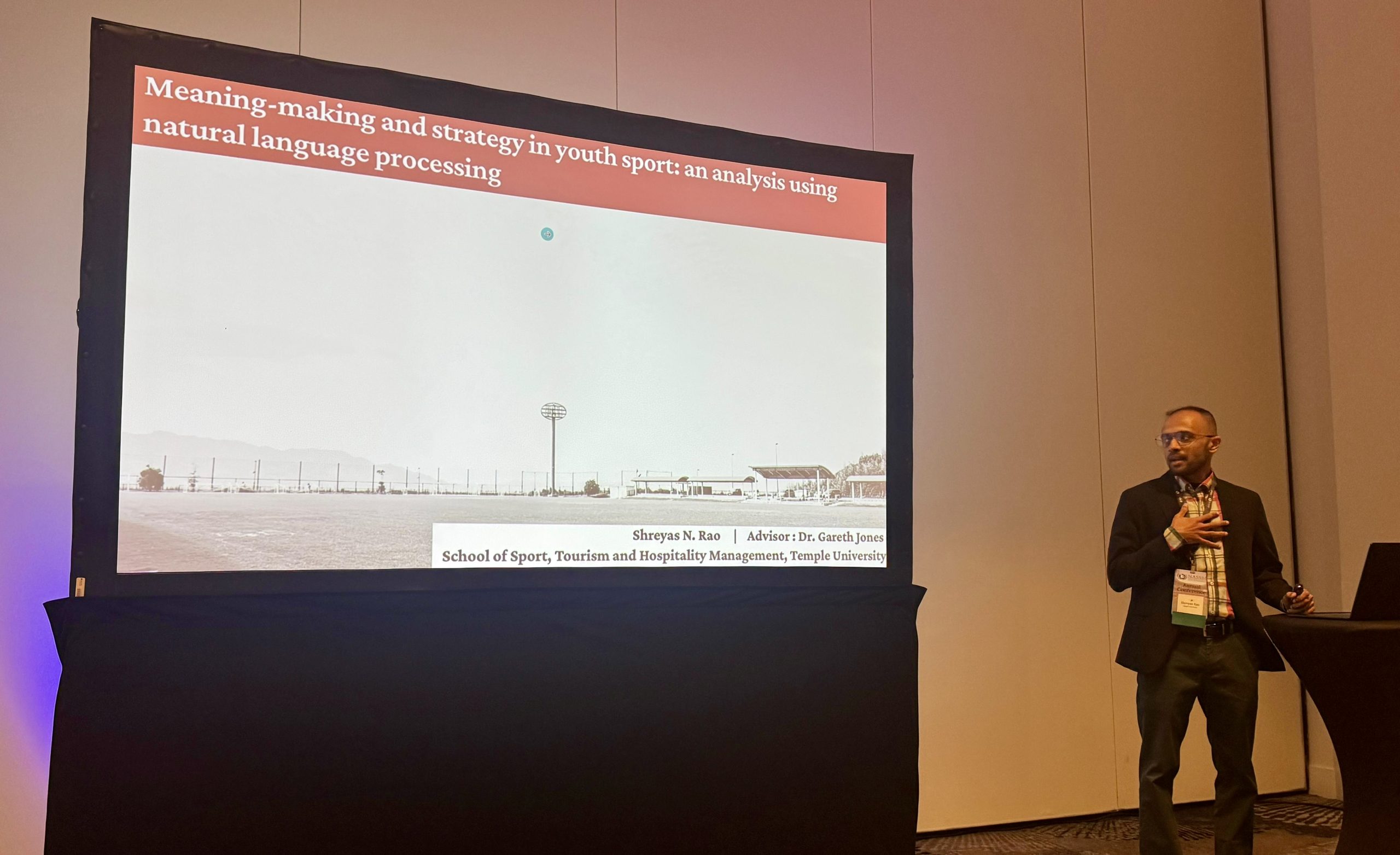
School of Sport, Tourism and Hospitality Management (STHM) PhD student Shreyas Rao research project, “Meaning-Making and Strategy-Building for Community Impact: An Analysis of Initiatives by Youth Non-Profit Organizations Using Natural Language Processing” examines how the choice of words in organizational communication impacts the sustenance of youth sport non-profit organizations.
(Photo courtesy of Shreyas Rao)
In relation to the GRASP award, Rao explained his research project’s unique tie-in to sustainability.
“Sure, when people think of sustainability, they think of concepts like waste management, environmental solutions, or green energy,” Rao said.
“But sustainability also has a lot to do with the areas of community building, youth development, conflict resolution and poverty alleviation, which are all concepts that I find the youth sport space are also working toward.
“Besides, our research goes beyond the practice-oriented view of sustainability to uncover how it is understood and articulated in the first place.”
The Temple community also recognizes the importance of Rao’s work.
“This award not only speaks to the importance of Shreyas’ research, but also to his willingness to explore topics that bridge multiple disciplines,” said Gareth Jones, an associate professor at STHM and Rao’s academic advisor.
“Not only is this project timely, as we have observed a trend of youth sport organizations struggling to acquire the attention and resources needed to deliver programming, but it also highlights the important role that these groups play in helping children develop and find community.
“It is a pleasure to work with such a driven and talented student like Shreyas, and I know I speak for everyone at STHM when I say we are thrilled for him to receive the 2026 GRASP award.”
In addition, the work he is doing aligns well with the core values of STHM.
“Shreyas’s innovative research exemplifies STHM’s commitment to knowledge creation that makes a meaningful difference beyond academia,” said Amy Giddings, associate dean at STHM.
“By using advanced research methods to help youth sport organizations strengthen their strategies, secure resources and expand their community impact, his work demonstrates the powerful connection between rigorous scholarship and real-world application. We are incredibly proud of Shreyas and thrilled to celebrate this well-deserved recognition.”
As Rao’s research continues throughout the summer and into the fall 2026 semester, he pauses to express gratitude for the recognition and support he’s received.
“I’m thankful for the recognition and validation that this GRASP award offers myself and my work,” Rao said.
“Whether through an award like this, or from support by the STHM community, I remain very motivated to continue doing impactful research within the youth sports industry in hopes to better our surrounding communities.”