
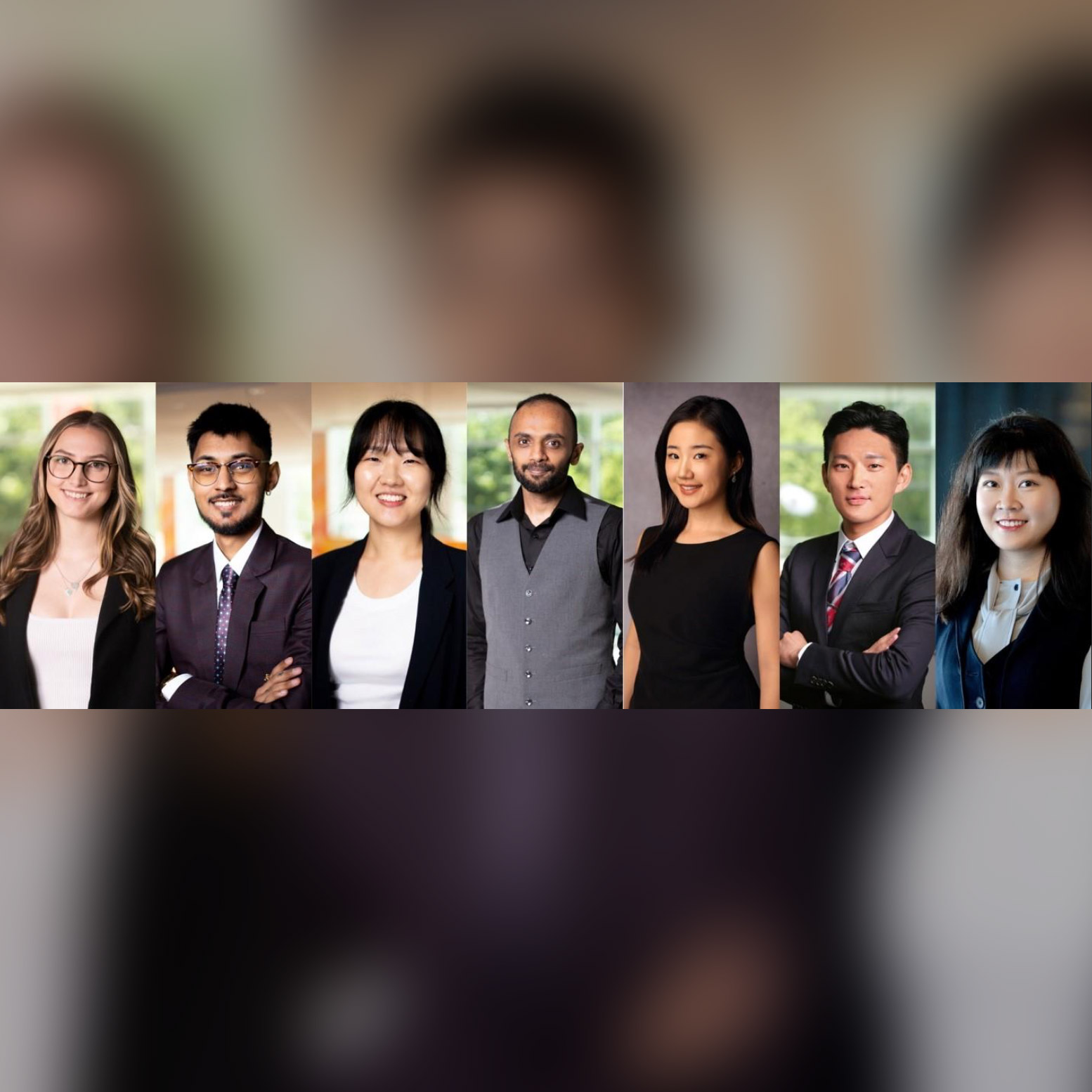
Students in the current PhD cohort include (from left) Scarlett Baughman, Pratyush Yadav, Jiwon Choi, Shreyas Rao, Boyan “Candice” Wang, Gyusang “Kevin” Hwang and Xinyi Yang. (Photo illustration by Sebastian Schroeter)
When the current group of tourism and sport PhD students at Temple University’s School of Sport, Tourism and Hospitality Management (STHM) first arrived in Philadelphia, they brought vastly different histories, ambitions and expectations with them.
By the end of their first semester together though, they realized that what they had found at Temple was more than a doctoral program: they had found a community built on shared challenges, support and the collective belief that nobody should move through a PhD alone.
Choosing the PhD path
Scarlett Baughman, a New York City native, describes her path to the PhD as a natural evolution from a master’s program where she discovered the joy of both teaching and academic inquiry.
“I realized how much I loved teaching and helping students understand why research matters during my time in my master’s program working as a teaching assistant at the University of Nevada, Las Vegas,” Baughman said.
“And at the same time, I found myself increasingly drawn to the research side while completing my thesis. I’d ask myself, ‘How I could combine those two passions together?’ Pursuing a PhD made the most sense to me.”
Born and raised in China, Boyan “Candice” Wang saw research as a way to translate personal experience into broader understanding.
“Being a former tennis player was a big part of my identity growing up,” Wang said. “As I continued my studies, I realized how important it is for me to just explore things around my personal experience, especially relating to athlete identity transitions and psychosocial processes. I decided to apply for a PhD so I could connect everything I’ve learned and experienced and relate them to sport.”
Although Shreyas Rao spent a decade working in youth sport in India, research was an anchor he kept returning to.
“The one thing that was common through my jobs was that I continued to gravitate toward research, specifically looking at learning design within youth sport,” Rao said. “That pull, the nascency of the sport industry in India and my hopes of becoming an educator made getting my PhD the next logical step.”
Pratyush Yadav, born and raised in India, summarized his winding academic path from astrophysics and applied math to sport business as a testament to staying curious.
“While the topic I’m focused on is different, the only thing that’s really changed has been the questions I ask,” Yadav said.“Contributing to a field that I’m passionate about is still there—the PhD is the path that gave me the platform and opportunity to contribute theoretically and practically.”
Temple is the right fit
Rao was clear that his decision rested – above all else – on mentorship.
“Something I heard that was very crucial for me was to get the right advisor: someone who shares your interest but also sees the world in the same way that you do, has pursued the kind of research you wish to conduct, and is generally a nice person,” he explained.
“I spent a lot of time reaching out to advisors, and with Dr. Gareth Jones, it just fell into place. We really connected and I think that was a big part of the reason I chose Temple.”
Wang was drawn to the academic structure.
“The program is unique because it combines a lot of studies from business with sport that you don’t get in many sport PhD programs,” Wang said. “That, plus the relationship with my amazing advisors, made Temple the best choice for me.”
For Yadav, the academic rigor was a selling point.
“When I looked at the curriculum and talked to faculty, I could tell the program doesn’t just teach you content — it teaches you how to think,” Yadav said. “There’s a structure and intensity here that prepares you to be an independent researcher, not just a graduate student.”
Gyusang “Kevin” Hwang’s path from South Korea to Temple was influenced by his interest in the social aspects of tourism and hospitality and guidance from mentors.
“Originally, I applied to more traditional recreation and leisure programs,” Hwang explained. “Some of my advisors and peers from grad school encouraged me to look at business schools, more specifically Temple’s.”
After meeting with students, seeing the ensured challenge and growth the program could offer him, and receiving support from the school to enter the program, STHM immediately became his top choice.
Cohort feels like family
The students also described their surprise at how close the cohort became and how quickly that happened.
Hwang likes the intentionality that their cohort has when it comes to spending time with one another.
“PhD students are often independent, but if we are in the office, we mostly keep our doors open to chat and get together as a group outside of school,” he said.
Yadav felt welcomed long before he even arrived in Philadelphia.
“I talked to multiple students who were currently in the program or were joining the program alongside me, and they were so open and honest,” Yadav said.
“Shreyas was especially helpful even before I started, which was very reassuring; he was there for me whenever I needed it, including when it came to navigating the visa process.”
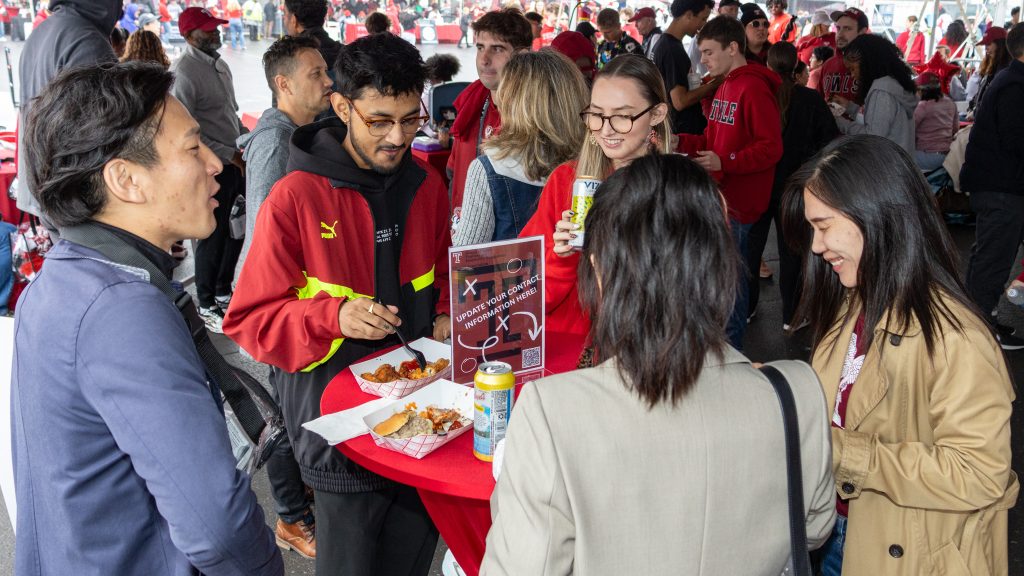
Baughman sees this dynamic as the heart of their shared experience.
“This is honestly the most supportive cohort I could’ve imagined,” she adds. “We have a strong culture of ‘if one of us wins, we all win.’ I could text any of them right now with a problem that I don’t know how to solve and they would help me through it.”
Rao echoed this feeling, especially when it came to how the cohort adapts.
“What’s unique about a PhD cohort is that the people change each year, so life within the cohort changes,” he explained. “I was lucky to be with a group, including a few upperclassmen, who worked together to help each other. Setting a tone like that makes you want to offer that same thing to those that come after you.
“Also, I appreciate having a wide range of diversity amongst our group—it only strengthens us as a group of students and individual people.”
This wide range of diversity is something that Xinyi Yang, a Chinese native with a background in sport media production, also values highly.
“My cohort members have very different research interests, which makes our discussions both diverse and inspiring,” she said. “When I was preparing for my preliminary exams, everyone offered both academic and emotional support. Shreyas shared literature he had read, others checked in with me via text messages to see how I was feeling, and many of them came in person to support me during my oral defense.”
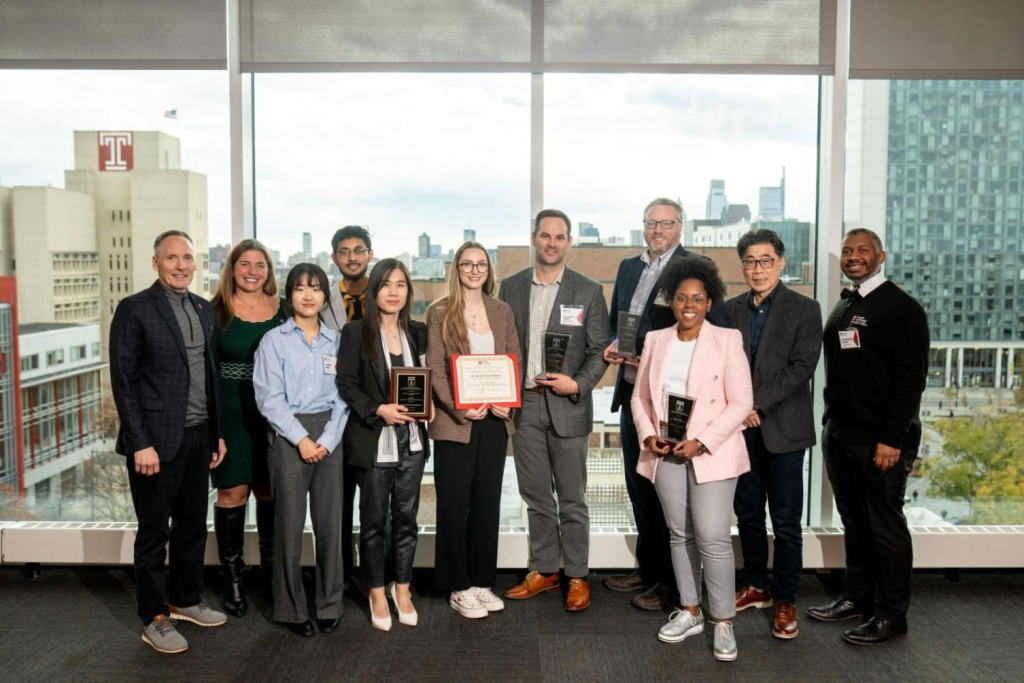
They not only share their lives together, but they also celebrate each other achievements. They make sure to show up for each other when they present their research or receive an award, including at a recent Research Roundtable Awards ceremony.
Faculty are key to connections, success
One of the most consistent themes across the cohort was the role of faculty in shaping their academic and personal development.
For Wang, her advisor’s support extended beyond the program itself.
“My advisor brought in another professor from a different university because she thought their perspective would help my project,” she explained. “That kind of mentorship is super valuable.”
Baughman shared how faculty involvement goes beyond expectations.
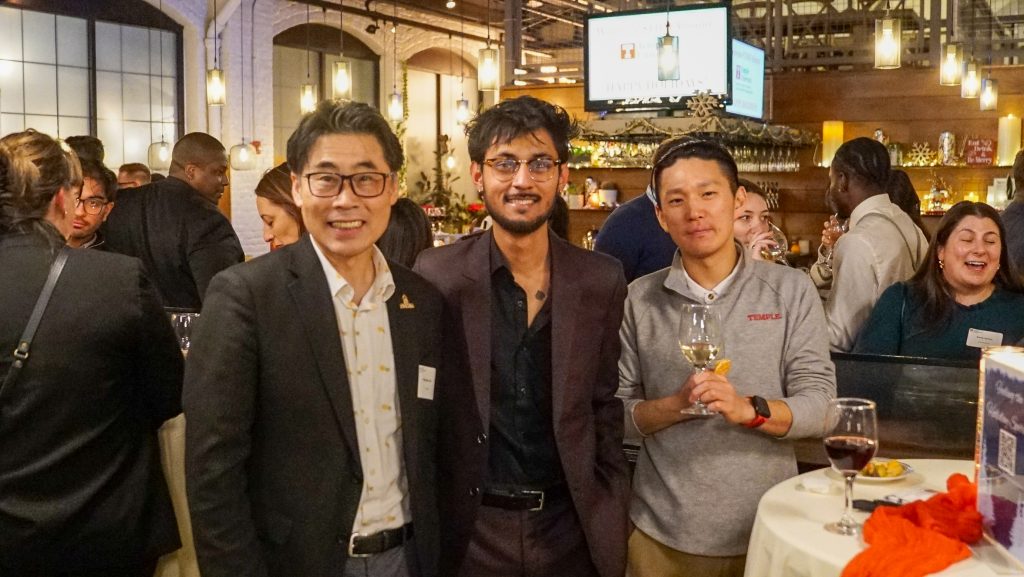
“When we’re preparing for a conference, the faculty will show up after long days just to help us practice,” she said. “They give hard feedback, but in the most constructive way. They really invest in us becoming better scholars.”
Adjusting to Philadelphia
For many, moving to Philadelphia meant adapting to a new city, culture or academic rhythm. However, their newfound network helped them through the process.
“Like any big city, Philly has its pros and its cons, but it grew on me,” Rao shared.
“The more I explored and the more I settled into a rhythm with the cohort, the more it started feeling like home.”
Choi finds the classroom dynamic different than what she’s used to but still loves learning.
“Usually in South Korea, I don’t speak that much in the classes,” Choi said of where she lived prior to coming to Temple. “Professors usually just lecture us, and we just take notes, but here we have discussions that invite everyone to deliver their thoughts and opinions.”
Hwang has managed a dynamic of staying close to campus and his cohort while also exploring other areas when he has the chance.
“Sometimes navigating the cold weather is tough for me but coming to campus and knowing how enjoyable it is to be with our cohort, makes the season that much better,” Hwang said.
Yang, however, has found that Philadelphia feels similar to her hometown of Tianjin, which is just a couple of hours south of Beijing.
“My hometown is a sister city of Philadelphia, and the two cities are located at nearly the same latitude,” she said. “As a result, they share very similarweather patterns and clearly defined seasons.
“Quite often, when it snowed or became windy back home, the same thing would happen in Philadelphia. In that sense, living here has given me a comforting feeling of being at home.”